Newton's empty lots could become starter homes under new ballot measure
Question 7 aims to cut land requirements for single-family houses, a move that may change housing dynamics in the Greater Boston region.
By Yasmin Nasser ·
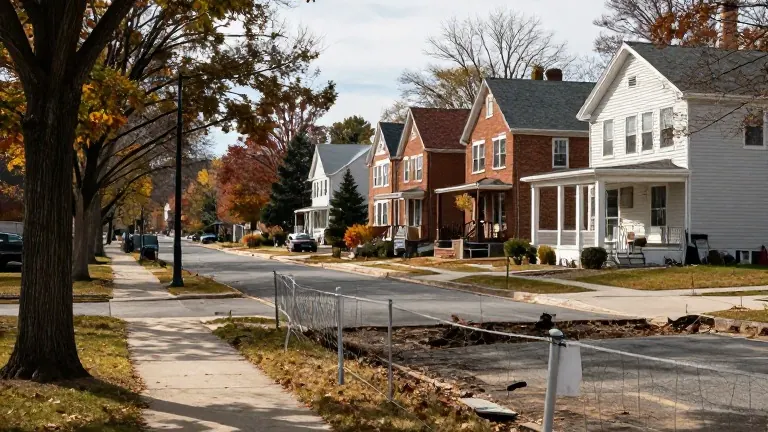
On Beethoven Avenue in Newton's Waban neighborhood, the landscape has shifted dramatically over the last ten years. Large, modern homes have replaced the smaller bungalows that once lined the street. One property, valued at $1.5 million in 2025, was recently demolished. In its place stands a 5,500-square-foot house currently listed for $4.3 million. Under a proposed state law, that same lot could have supported two smaller residences instead of one.
This pattern illustrates a growing concern across Massachusetts: the disappearance of starter homes. Local zoning rules in many communities require large parcels of land for a single house, making it economically difficult to build modest homes. Question 7, a ballot measure on the November election, seeks to change this by lowering the minimum lot size required for new single-family construction.
The measure would establish a statewide standard allowing houses on residentially zoned lots of 5,000 square feet or larger, provided they have access to water, sewer, and at least 50 feet of road frontage. Currently, many towns in eastern Massachusetts require an acre of land for a single-family home. If passed, the law would allow builders to construct multiple homes on land that previously could only support one.
Supporters argue this will make housing more accessible. Jeff Brem, president of Meisner Brem Corp, a land surveying firm in Westford, said the measure makes previously undevelopable lots usable. "You're basically taking a bunch of lots across the state that it didn't make sense to build on before and making them developable," Brem said. He noted this would lower land costs and allow builders to construct cheaper homes, though he cautioned they would not necessarily be "affordable." The campaign for the measure estimates it would add between 2,200 and 5,700 net new homes to the state annually.
The economics of construction drive the current trend toward larger, pricier houses. Paul McGovern, owner of McGovern Construction Management in Needham, explained that land prices in the region are extremely high. In Needham, a buildable lot can cost around $1.2 million, while construction costs are near $1 million. To make a profit, builders often construct homes selling for $3 million to $4 million rather than smaller homes that might sell for $2.4 million. McGovern said that if the new rule passes, builders in areas with lower land costs, like Chelmsford, might be able to build two or three houses on lots that currently support only one.
The proposal has strong backing from state leadership, including Governor Maura Healey and Boston Mayor Michelle Wu. The main opposition comes from the Massachusetts Municipal Association, which represents cities and towns. The group argues the measure erodes local control over land use. Some suburban voters also worry the law will increase density in their neighborhoods.
Critics question whether the measure will actually create affordable housing. Susan Murphy, a land-use attorney, said the change could incentivize builders to tear down older, cheaper homes. "I agree that we need to make it far more affordable to buy a starter home here," Murphy said. "But you're not going to get affordable prices on a 5,000 square-foot lot inside Route 128." She argued that high construction costs mean even smaller new homes will remain expensive, particularly in areas close to Boston.
Opinions on the measure are divided among voters. A Suffolk University and Boston Globe poll released this week found that 41 percent of voters support the measure, while the same percentage oppose it. The Tufts University Center for State Policy Analysis estimates the measure would add fewer homes than the campaign suggests, predicting between 350 and 1,200 new homes per year. Deborah Crossley, a former Newton city councilor who led the city's zoning and planning committee, acknowledged the measure is blunt but noted its potential benefits. "It's a bit of a sledgehammer on a problem that requires a nuanced approach," Crossley said. "But more housing is more housing."
The issue dates back to the post-World War II era, when suburbs developed rapidly with small, affordable houses. By the 1960s, suburban towns began passing zoning rules to limit growth, including minimum lot size requirements. As demand for housing in the Greater Boston area increased and buildable land decreased, builders focused on larger projects. Question 7 attempts to reverse this trend by making it legal to build on smaller lots. The outcome of the election will determine whether this new standard takes effect across the state.
Source: The Boston Globe · original report published
More News · Lewiston news · Report a business · Got a Story?