Massachusetts voters approve public records expansion
Voters in the Commonwealth backed five of nine ballot questions, expanding access to state records and allowing same-day voter registration.
By Dominic Foster ·
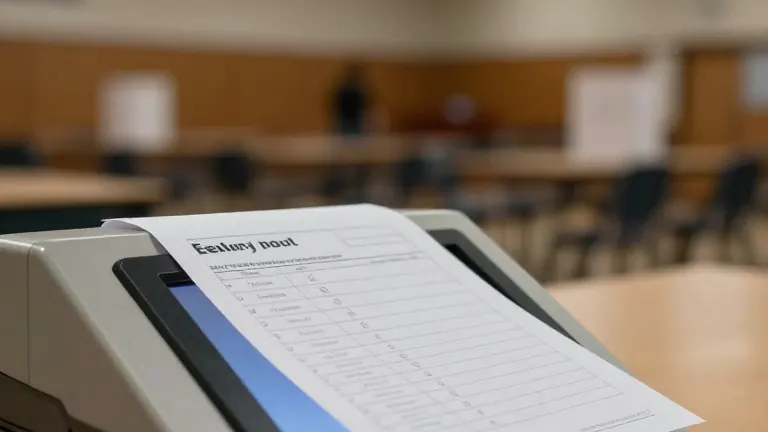
Massachusetts voters approved a major expansion of the state’s public records law on Tuesday, marking a shift in transparency for the governor’s office and the state Legislature. The Associated Press projected the passage of Question 1 shortly before midnight. This measure subjects both the governor’s office and the Legislature to the rules governing public access to government information. Previously, the Legislature was exempt from these requirements. Governor Maura Healey had argued that a 1997 state Supreme Judicial Court decision exempted her office as well. The new law still allows elected leaders to withhold records used for policy development and constituent communication.
Voters also approved Question 4, which permits eligible U.S. citizens to register at their polling place on Election Day. This change removes the previous requirement for citizens to register at least 10 days before the election. Question 2 passed with support from approximately 64 percent of voters by Wednesday morning. This measure grants state public defenders and other employees at the Committee for Public Counsel Services the ability to form a union. The measure does not require them to unionize, but it provides the legal right to do so.
Question 6 allocated a portion of sales tax revenue from certain outdoor activities and equipment to a new nature conservation fund. Proponents argued this could raise up to $100 million annually for land protection and waterway cleanup. By Wednesday morning, 61 percent of voters supported the measure. Question 9 upheld a 2024 gun control law that regulates ghost guns, expands the state’s red flag law, and creates new mandates for gun training and licensing. The AP projected that 67 percent of voters chose to uphold the law, rejecting calls to repeal parts of the statute.
Three questions were rejected by voters. Question 3 would have replaced the current partisan primary system with a single ballot listing all candidates regardless of party. With roughly 80 percent of the vote counted at 7 a.m., a majority had rejected the measure. Question 5 proposed a new formula for calculating the state’s annual tax revenue limit. The Mass Opportunity Alliance, a business advocacy group, conceded defeat Wednesday morning. Question 8 asked voters whether to end adult-use cannabis sales a decade after legalization. The AP projected the measure would fail, keeping the recreational marijuana market in operation.
The outcome of Question 7, which sought to shrink the minimum lot size for single-family homes statewide, remained uncertain as of Wednesday morning. The AP had the “no” side leading with 88 percent of ballots counted. This measure was intended to make housing construction easier and put homeownership within reach of more families. Daniel Dangond, a 28-year-old unenrolled voter in Cambridge, noted that ballot questions often feel more consequential than candidate races. He said, “It feels like in a state like Massachusetts, it doesn’t really matter who you vote for.”
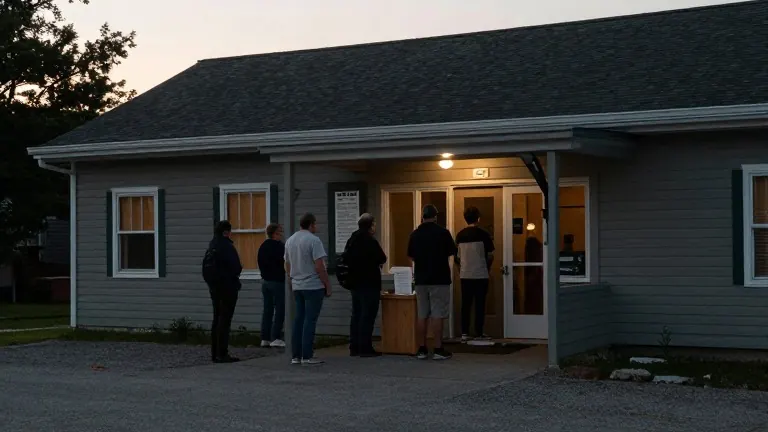
Voters faced a high volume of initiatives, including questions on state primaries, public defenders’ union rights, and conservation funds. Mohamed Warsame, a 53-year-old Democrat in Cambridge, supported the expanded public records law despite doubts about its impact. He stated, “Even if we win, I think they [will] change the law.” Chuck Foltz, who voted at the Lower Mills library, supported eliminating party primaries to increase competition. Chris Lemmons, a 39-year-old independent from Wakefield, voted against the primary change, saying, “That’s just inviting tons of money to flood the races.”
David Keenan, a registered Democrat from Dorchester, argued against repealing cannabis laws, noting that an entire industry has been established since legalization. He said, “Disrupting that entire industry would be a problem.” Jenna Wright, a 26-year-old Democrat in Cambridge, brought a cheat sheet to the polls to navigate the nine questions. She said, “I’ve never had to vote on so many questions.”
More News · Lewiston news · Report a business · Got a Story?