Milei offers tax cuts and no rules to lure AI data centers to Patagonia
Argentina’s president is pitching the southern plateau as a regulatory haven, promising a 15% corporate tax rate for billion-dollar projects while environmental groups and local residents question the plan.
By Yasmin Nasser ·
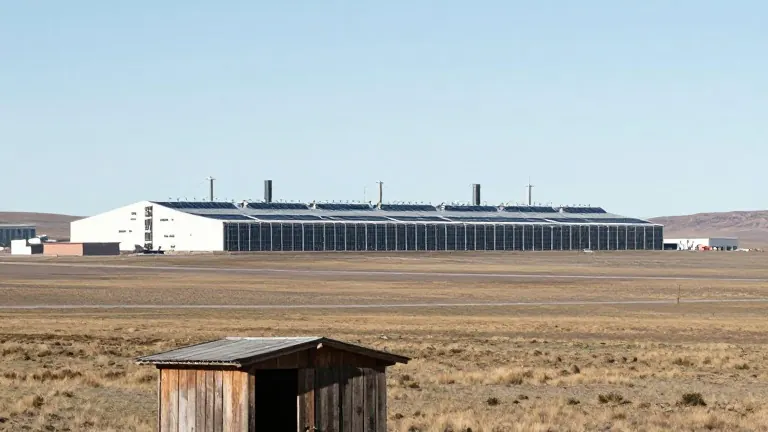
President Javier Milei is positioning Argentina as a primary destination for artificial intelligence infrastructure, offering foreign tech giants a jurisdiction with minimal regulation and steep tax incentives. The proposal aims to attract data centers to the Patagonia region, where vast land and energy resources are available, while the rest of the world debates the environmental and social costs of such facilities.
Milei told the U.S. Chamber of Commerce last month that Argentina would not regulate artificial intelligence, leaving the sector free to operate. To support this stance, the government is advancing a bill that would reduce the corporate income tax rate from 25% to 15% for projects worth at least $1 billion in emerging industries. The measure is currently awaiting Senate approval. Visitor logs reviewed by The Associated Press indicate that representatives from OpenAI, Amazon, Google, Oracle, and venture capitalist Peter Thiel have met with Milei and his aides in recent months.
Geographic factors drive the appeal of the Patagonian plateau. The region offers cold climates for cooling servers, strong winds for renewable energy, and access to the Vaca Muerta shale deposits. Marta Zlotkowska, head of international development at Green Capital, stated that her company selected Argentina for its $3 billion data center project after comparing potential locations globally. The Polish renewable energy firm plans to build the campus to lease computing capacity to major tech firms, though it has not yet secured a customer.
Local officials view the projects as a vital economic shift. Rubén Etcheverry, a top official in Neuquén province, noted that investors are now looking at the region due to energy shortages and rising costs elsewhere. Pampa Energía, a major power company, has announced plans to supply gas-fired power to a data center near Vaca Muerta. In Chubut province, 14 landowners have leased 130,000 hectares of land to Green Capital. Francisco Sáenz, a fourth-generation sheep farmer, said ranchers are seeking alternatives to the declining wool industry while planning to continue grazing sheep alongside the future server farms.
Critics argue the incentives do not require companies to reserve computing capacity for local use or disclose resource consumption. Alan Rocha Varsanyi, a researcher at Observatorio Petrolero Sur, said the computing power would likely be exported to other countries. Nicolás Wolovick, a computer science professor at the National University of Córdoba, warned that the lack of rules could turn Argentina into a testing ground for AI technologies without safeguards against surveillance and cyberattacks.
Construction on the Green Capital project is not expected to begin until around 2028. The finished campus would consume approximately 2.7 times the annual electricity of Buenos Aires at peak demand. In Trelew, residents have organized under the banner “Trelew Free of Data Centers,” expressing concern over water usage and environmental impact. The opposition in Congress has stalled Milei’s plan to allow AI agents to control companies, while a senior government official noted that companies are waiting for clarity on rules regarding copyrighted works and data transfers.
Milei is scheduled to host Pope Leo XIV in Argentina next week as part of the pontiff’s Latin American tour. The visit comes as some investors wait until after next year’s presidential election before committing funds, fearing that a change in government could reverse free-market reforms. Andrés Arbeletche, a cabinet coordination secretary for Chubut, said the province is working to convince investors that Argentina remains a stable place for business regardless of political shifts.
More Business · Rip-Off Report · Report a business · Got a Story?