Spanish Train Operator Ordered RENFE Moving With Stop Signal Active, Minister Says
Transport Minister Óscar Puente said a central command center told a RENFE train to proceed after a security system failed, and it struck a stationary IRYO train at 8:53 a.m.
By Yasmin Nasser ·
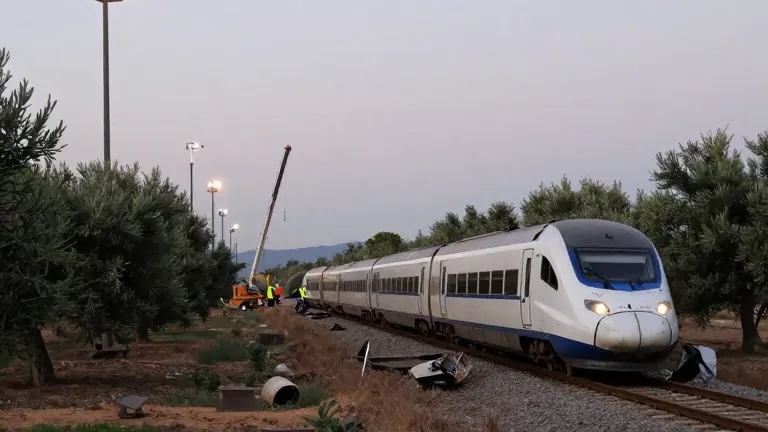
Transport Minister Óscar Puente said Spain's second high-speed rail disaster of 2026 began with an order he called "inexplicable." A central command center instructed a RENFE train to resume travel after a security system failed on a 63-kilometer stretch of track, and it collided with a stationary IRYO train at 8:53 a.m. on Wednesday near the town of Urda in the province of Toledo. The crash killed 68 people.
Puente said the security system on that stretch stopped working at 8:30 a.m. because of a computer malfunction, and all trains on the segment halted. The IRYO train stopped near Urda. The RENFE train was 25 kilometers behind it. Minutes later, the central command told the RENFE train to start running again with no speed restrictions. Puente said the train should not have been told to move while a stop signal was active, and that any movement should have been at reduced speed. He said the train engineers were not to blame.
The collision occurred on a stretch of rail lined by olive groves. Spanish Prime Minister Pedro Sánchez visited the site after regional authorities confirmed more than 60 deaths and said dozens more people were being treated at hospitals. Sánchez's government declared three days of mourning starting Thursday, and cranes began moving damaged train parts late on Wednesday after hundreds of emergency workers, firefighters, police and soldiers worked through the day to rescue survivors and recover bodies.
Spain's high-speed rail network ranks second worldwide in track mileage behind China. It began service more than three decades ago and had not seen a deadly crash until January of this year, when 46 people died in a collision in southern Spain after one train left the tracks and struck another traveling the opposite direction. Both crashes this year involved a train operated by state-owned RENFE and one from privately held IRYO. Spain opened its high-speed rail service to private operators in 2021, and IRYO began running service the following year. The network carried 45 million travelers last year.
The timeline leading to Wednesday's crash sits four weeks before Spain's national election, its first since 2023. About an hour before news of the collision spread, Sánchez posted on X that "There are lots of reasons to be optimistic about this country." He has called for early elections amid discontent over housing costs and high rents. Polls show his Socialist party faces a difficult race. His government also faces right-wing criticism of his migration policies and corruption accusations against the party and his wife, which both he and his wife deny.
Sánchez pledged an investigation into the crash and safety improvements. "It is clear that we need to reinforce the safety of our train service to rebuild the trust in our high-speed rail," he said. "It is not acceptable for a country like Spain to endure two high-speed train accidents in the same year." Puente, asked whether he would resign after a second major wreck under his watch, said he was focused on the collision, not his future.
Popular Party leader Alberto Núñez Feijóo demanded a full investigation and canceled his party's campaign events for the day. "This is the moment to respect the dead, the injured and their families," he said. "That does not mean we will ignore the fact that Spaniards are asking tough questions that demand answers." Far-right Vox leader Santiago Abascal wrote: "More dead. Another tragedy. More rage over being left to fend for ourselves, the despair and the betrayal that Spaniards are enduring."
Workers used cranes to move parts of the damaged trains late Wednesday. The country observes three days of mourning beginning Thursday.